Whether we like it or not, science is shaping the world that
we live in today. We are “witnessing the rise of a neuroculture” according to
Giovanni Frazzetto and Suzanne Anker (Frazzetto). Almost every scrap of media
that reaches our eyes and ears, every billboard to commercial is precisely
built, based on psychological tendencies and our resulting behavior. In fact, we’ve come to understand that the
world each of us perceives is built completely within our head and is dependent
on what goes on in our brains. But we must put our understandings of psychology
to better use than advertisement; endless psychological solutions to every day
problems exist according to Rory Sutherland. Should we spend more money on a
faster train system or instead pay much less to add free wifi and make the trip
appear much less long (Sutherland)? Similarly, Sir Ken Robinson argues that
psychological solutions should be used to reform our outdated education system
(Robinson).
 |
| http://davidrothman.net/wp-content/uploads/2008/08/davidotox.png |
Additionally, neuroscience has continued to influence the
artistic hemisphere of our culture, from Cajal’s beautiful drawings of neurons
to Greg Dunn’s intricate etchings and gold-leaf prints of like structures,
artists continue to explore this realm today (Dunn). Artist Megan McGlynn fuses
her understanding of the brain and art through mysterious and complex
architectural sculptures. As view observes the sculptures more closely, they
begin to realize that there is a hidden complexity and addition of detail to
these structures, just like the brain. According to McGlynn, like when viewing
an beautiful building, viewing her sculptures leads people to wonder how such a
thing was built, what “anatomical building blocks” were necessary to build such
a mysterious thing (McGlynn).
 |
| http://thebeautifulbrain.com/wp-content/uploads/2013/09/Screen-shot-2013-09-05-at-4.26.12-PM-300x252.png |
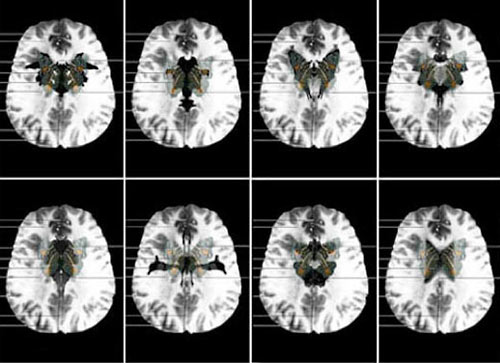
While McGlynn explores the mysteries of the brain, Suzanne
Anker argues that despite the discrepancies between the unique minds of
individuals, there is a commonality present between us. Her one of her pieces
displays many MRI scans that contain a simple butterfly-like shape upon each
one. Although each shape is different, they unquestionably resemble the same
thing (Vesna).
 |
| http://www.dataisnature.com/images/MRI_Butterfly_Suzanne_Anker.jpg |
Consciousness is defined as a personal or collective sense
of identity. With every advance in neuroscience and every new artistic
exploration of these topics, we further develop a collective understanding of
ourselves and shape a group consciousness that we share as a species.
References
Dunn,
Greg. Greg Dunn Design. Greg Dunn, 2013. Web.
Frazzetto,
Giovanni, and Suzanne Anker. "Neuroculture." Nature Reviews
Neuroscience Nat Rev Neurosci: 815-21. Print.
Neuroscience-Mark
Cohen.mov. Perf. Mark Cohen. Ucdesma's Channel, 2012. Film.
McGlynn,
Megan. "Gallery Interview: Megan McGlynn." The Beautiful Brain. Word
Press, 9 Sept. 2013. Web.
RSA
Animate - Changing Education Paradigms. Perf. Ken Robinson. RSA Animate, 2010.
Film.
Sutherland, Rory. "Rory Sutherland: Perspective is
everything." TEDxAthens. TED Talks. , Athens. 1 Dec. 2011. Lecture.
Neuroscience-pt1.mov.
Perf. Victoria Vesna. UC Online Program, 2012. Film.

No comments:
Post a Comment