Sunday, May 24, 2015

Week 8 - Nanotechnology and Art

With the development of the Scanning Tunneling Microscope and the “Buckey-Ball”, our generation has experienced a drastic paradigm shift that has allowed us to “feel” the previously invisible nanoscopic world (Gimzewski). Nanotech was first mentioned by Norio Taniguchi, and the word is derived from the Greek word for dwarf.  The word dwarf, however, does not even come close to describing just how small things in the nanoscopic world are. One nanometer is one billionth the size of a meter, so small that a wavelength of light is larger, meaning that things in the realm do not “exist” in the visible world (Vesna & Gimzewski). Luckily, however, the Scanning Tunneling Microscope has allowed us to visualize particles on this level by “tracing” over the surfaces of atoms. This has also lead to the realization that we have the ability to manipulate individual atoms to build complex structures “at the bottom” as physicist Richard Feynman puts it (Gimzewski).

http://www-03.ibm.com/ibm/history/ibm100/images/icp/O615894E37594U80/us__en_us__ibm100__scanning_tunnel__microscope__400x269.jpg


These nano-scale discoveries have lead to development of many new technologies such as hydrophobic substances, modified foods and tiny circuits. Interestingly enough however, the “fact and fiction” of nanotechnology have somewhat of a reciprocal relationship. It’s not so much that our nanotech creations have shaped our science fictions novels, games and culture, rather, these two realms appear to shape one another. For example, nano-scientist and engineer Michael Crichton writes science fiction to shape our “collective nano-consciousness” (Gimzewski & Vesna). Nanotechnology has also appeared in other art forms. The game series Metal Gear Solid often explores the topic of nanotechnology in a military setting, while the 2004 James Bond video game Everything or Nothing revolves around a destructive nanotech substance (Everything or Nothing). All of these examples share the characteristic of depicting nanotechnology as powerful: something that can be used with constructive or destructive intention. For example, Everything or Nothing does not merely depict nanotechnology as a destructive, it is also the technology that power the protagonist’s many gadgets, allowing him to control tiny spy spiders or become invisible.

https://s-media-cache-ak0.pinimg.com/236x/5d/bb/7f/5dbb7fbecacdd9d01e81945f65853f71.jpg
http://img.gawkerassets.com/img/17fdiyzqjvz5yjpg/original.jpg


As I suggested earlier, some of these fictional gadgets are also influencing scientists today. In Japan, scientists are Tachi Lab are developing a fully functional invisibility cloak (OpticalCamouflage).


However, it is only natural for fiction to outrun reality, for unbounded imagination to dream up the future. It’s exciting to fathom the possibility of biomimicry, nano-medicine, self-organization and nanoscopic circuits. The future is here, we’ve dreamt it, now we must make it a reality.

References
Gimzewski, Jim, and Victoria Vesna. "The Nanomeme Syndrome: Blurring of Fact & Fiction in the Construction of a New Science." UCLA Arts Publications (2004). Print.
James Bond: Everything or Nothing. MGM Interactive. Griptonite Games. 11 Feb. 2011. Video game.
Nanotech Jim Pt1. Perf. Jim Gimzewski. UC Online Program, 2012. Film.
Neibert, Kevin. "How Nanotechnology Is Portrayed in Video Games – The Metal Gear Solid Saga." Kotaku. Kotaku, 23 Apr. 2012. Web.
OpticalCamouflage. 2009. Film.


Monday, May 18, 2015

Week 7- Neuroscience + Art

Whether we like it or not, science is shaping the world that we live in today. We are “witnessing the rise of a neuroculture” according to Giovanni Frazzetto and Suzanne Anker (Frazzetto). Almost every scrap of media that reaches our eyes and ears, every billboard to commercial is precisely built, based on psychological tendencies and our resulting behavior.  In fact, we’ve come to understand that the world each of us perceives is built completely within our head and is dependent on what goes on in our brains. But we must put our understandings of psychology to better use than advertisement; endless psychological solutions to every day problems exist according to Rory Sutherland. Should we spend more money on a faster train system or instead pay much less to add free wifi and make the trip appear much less long (Sutherland)? Similarly, Sir Ken Robinson argues that psychological solutions should be used to reform our outdated education system (Robinson).

http://davidrothman.net/wp-content/uploads/2008/08/davidotox.png


Additionally, neuroscience has continued to influence the artistic hemisphere of our culture, from Cajal’s beautiful drawings of neurons to Greg Dunn’s intricate etchings and gold-leaf prints of like structures, artists continue to explore this realm today (Dunn). Artist Megan McGlynn fuses her understanding of the brain and art through mysterious and complex architectural sculptures. As view observes the sculptures more closely, they begin to realize that there is a hidden complexity and addition of detail to these structures, just like the brain. According to McGlynn, like when viewing an beautiful building, viewing her sculptures leads people to wonder how such a thing was built, what “anatomical building blocks” were necessary to build such a mysterious thing (McGlynn).

http://thebeautifulbrain.com/wp-content/uploads/2013/09/Screen-shot-2013-09-05-at-4.26.12-PM-300x252.png


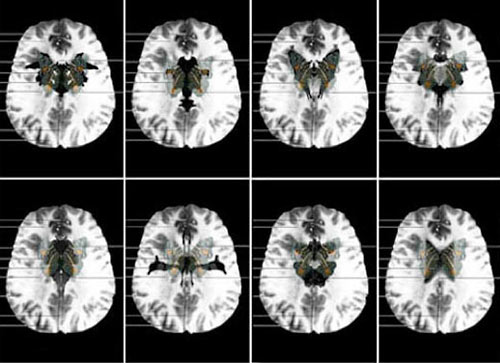
While McGlynn explores the mysteries of the brain, Suzanne Anker argues that despite the discrepancies between the unique minds of individuals, there is a commonality present between us. Her one of her pieces displays many MRI scans that contain a simple butterfly-like shape upon each one. Although each shape is different, they unquestionably resemble the same thing (Vesna).

http://www.dataisnature.com/images/MRI_Butterfly_Suzanne_Anker.jpg


Consciousness is defined as a personal or collective sense of identity. With every advance in neuroscience and every new artistic exploration of these topics, we further develop a collective understanding of ourselves and shape a group consciousness that we share as a species.


References
Dunn, Greg. Greg Dunn Design. Greg Dunn, 2013. Web.
Frazzetto, Giovanni, and Suzanne Anker. "Neuroculture." Nature Reviews Neuroscience Nat Rev Neurosci: 815-21. Print.
Neuroscience-Mark Cohen.mov. Perf. Mark Cohen. Ucdesma's Channel, 2012. Film.
McGlynn, Megan. "Gallery Interview: Megan McGlynn." The Beautiful Brain. Word Press, 9 Sept. 2013. Web.
RSA Animate - Changing Education Paradigms. Perf. Ken Robinson. RSA Animate, 2010. Film.
Sutherland, Rory. "Rory Sutherland: Perspective is everything." TEDxAthens. TED Talks. , Athens. 1 Dec. 2011. Lecture.
Neuroscience-pt1.mov. Perf. Victoria Vesna. UC Online Program, 2012. Film.


Monday, May 11, 2015

Week 5- Biotech + Art

We are entering a new era. Not long ago, the possibility manually altering life through manipulation of genes was deemed nothing more than a myth. In an era in which mice have been cloned from a single drop of blood (Briggs), we face certain ethical dilemmas. One issue involves the question of “Big Bio” versus “DIY Bio”. On one hand, large, regulated, well-financed, government-approved biotech projects might be safer and ethically sound, however, a Silicon Valley model for biotech research might lead to faster advancements in research and more medicinally-beneficial experimentation driven by personal interest and private funding (Yunes). Private funding, however, has its own caveats. A Silicon Valley model could lead to extremely unregulated and possibly grotesque research. This also inevitably leads to the question of the ethicality of genetic improvement or manipulation for artistic means.

http://rt.com/files/opinionpost/21/58/c0/00/000_par7319356.jpg


Like any frontier science or new technology, often it is the projects that provoke the questions of ethics and future regulations of the new practice. Artist Stelios Arcadiou has begun asking some of these questions, unintentionally perhaps, by having a third ear implanted upon his arm (Vesna). Life has become a medium of art in the case of Alba, a rabbit that is fluorescent in the presence of black light due to the splicing of jellyfish genes into its DNA. Another example are the flowers that are bred by George Gessert, which are selectively hybridized over and over to create new, aesthetically appealing forms.

http://blogs.smithsonianmag.com/artscience/files/2013/02/Designer-Genes-petunia-600.jpg


Things start to get really sticky when we delve into human experimentation and replication. Michael Bays’ film The Island explores the question of using genes to synthesize organs in surrogate humans (The Island). Although the movie is dramatized and action-oriented, this work of art poses some questions that are still being discussed today.  Should biotech research only be used to fix “problems” or can it also be used to improve forms of life? At what ethical boundaries should exist to keep us from destroying autonomous forms of life even if they are created in a lab environment?

http://memberfiles.freewebs.com/72/27/101372772/photos/undefined/NeXt_Img_The.Island_15.jpg


In order to address these questions, we must form a working definition of what life means, something that is still being debated today. Slime mold, for example, acts as one organism, however it is made up of genetically unique entities that posses their own “autopoesis” (Levy). Is it ethically acceptable to experiment on the colony of slime mold? If not, is it allowable to experiment on fragments of it even if they have their own unique metabolism? Do these questions apply to humans and our cells?

References

5 Bioart Pt1 1280x720. Victoria Vesna. UC Online Program, 2013. Film.
Briggs, Helen. "Mouse Cloned from Drop of Blood." BBC News 27 June 2013. BBC News. Web.
The Island. DreamWorks Home Entertainment, 2005. Film.
Levy, Ellen. "Defining Life: Artists Challenge Conventional Classifications." (2012). Print.

Yunes, Nour Diab. "Meanings of Participation: Outlaw Biology?" NourDiabYunes. Wordpress, 8 Feb. 2010. Web. 10 May 2015.